Iran’s Anti-Israel Ideology: Quds Day
Download PDFBackground
 Burning Israeli flags at a Quds Day rally in Tehran
On August 7, 1979, shortly after the Islamic Revolution, Ayatollah Khomeini proclaimed Quds Day as an annual day of solidarity against the “usurper Israel.” He declared:
"I invite Muslims all over the globe to consecrate the last Friday of the holy month of Ramadan as Al-Quds Day and to proclaim the international solidarity of Muslims in support of the legitimate rights of the Muslim people of Palestine. For many years, I have been notifying the Muslims of the danger posed by the usurper Israel which today has intensified its savage attacks against the Palestinian brothers and sisters, and which, in the south of Lebanon in particular, is continually bombing Palestinian homes in the hope of crushing the Palestinian struggle. I ask all the Muslims of the world and the Muslim governments to join together to sever the hand of the usurper and its supporters. I call on the Muslims of the world to select as Al-Quds Day the last Friday in the holy month of Ramadan- which is itself a determining period and can also be the determiner of the Palestinian people’s fate- and through a ceremony demonstrating the solidarity of Muslims world-wide, announce their support for the legitimate rights of the Muslim people. I ask God Almighty for the victory of the Muslims over the infidels.”
Quds Day fits into Khomeini’s revolutionary paradigm as a show of resistance in support of “oppressed peoples” against “arrogant, oppressive powers,” and Khomeini went so far as to issue a fatwa declaring the elimination of the “Zionist entity” as a religious duty incumbent on Muslims.
Iranian politicians abidingly attend Quds Day rallies and deliver anti-Israel diatribes to showcase their steadfast commitment to the regime’s opposition to Israel.
Quds Day: 2019 – Present
 Ballistic Missile on Display During 2017 Quds Day in Tehran
2019
Tehran’s May 2019 Quds Day festivities were centered around Iran’s rejection of the Trump administration’s forthcoming Israeli-Palestinian peace plan, branded as “the deal of the century.” The procession featured numerous examples of incitement, including demonstrators burning American and Israeli flags and effigies of President Trump and Prime Minister Benjamin Netanyahu. In remarks to reporters, President Rouhani declared, "Palestinians will definitely emerge victorious in confrontation with the Zionist aggressors. … The issue of Deal of the Century will undoubtedly turn into the bankruptcy of the century and will certainly not yield results."
Following the rally, the participants issued a communique in which they vowed to reject negotiations and back armed “resistance” as the only viable path to advance the Palestinian national movement. The statement proclaimed, “Liberation of the al-Quds and all other Palestinian territories from the Zionist (Israel) occupation is the main goal of the Islamic world. The only way to settle the issue of Palestine is to press ahead with resistance, to allow for the return of all displaced Palestinians from around the world to their motherland, and to hold a free referendum to decide the fate of their country."
2020
Quds Day in 2020 took place on Friday, May 22. Iran, which has been especially hard hit by the coronavirus, weighed canceling the 2020 demonstrations or moving them online. Ultimately, Iran decided to put on a modified Quds Day, which underscored that even a pandemic would not deter the Iranian regime from holding its annual display of demonization of Israel.
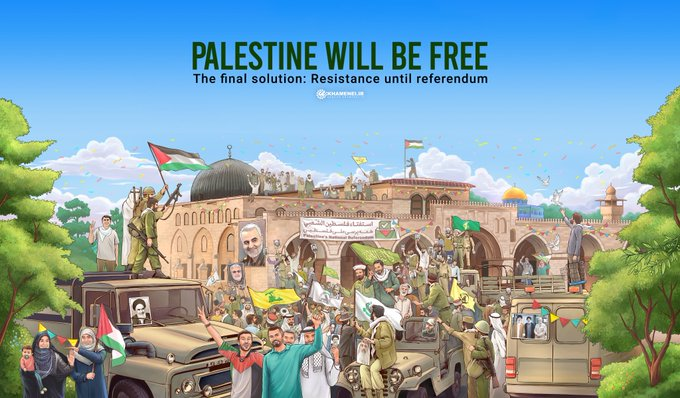
Ahead of the 2020 Quds Day, the Office of Iran’s Supreme Leader also released an anti-Semitic poster calling for “the final solution: resistance until referendum,” evoking Nazi-era rhetoric. The poster depicted Jerusalem following a Muslim reconquest with a poster of slain former IRGC-Quds Force commander Qassem Soleimani prominently displayed on the city’s walls.
2021
Although Quds Day events in Iran were canceled in 2021 due to the COVID-19 pandemic, the Islamic Republic’s Supreme Leader Ali Khamenei did not miss the occasion to disseminate propaganda and demonstrate his commitment to anti-Israel causes. His office frequently takes to the X platform, formerly Twitter, to encourage Palestinian violence against Israel. His tweets were so horrific that the Anti-Defamation League called on Twitter to close his account for violating Twitter rules that state users will be suspended if they “glorify, celebrate, praise or condone violent crimes.” The civil rights organization asserted that Khamenei’s tweets, which have a global reach, constitute blatant anti-Semitism.
On the night before Quds Day, May 6, 2021, in a ceremony in Esfahan, Iran, IRGC Commander-in-Chief Hossein Salami touted Iran’s missile program and Iran’s readiness to act militarily against Israel. "Israel could be blown up in a single operation," he said. Furthermore, Salami mentioned that attacks against Israeli interests, like those that occurred in April and May of 2021, could happen again. Some of those attacks, such as the April 13th attack on an Israeli commercial vessel, have Iran’s fingerprints all over them.
On Quds Day in 2021, Khamenei emphasized in a speech that “some weak Arab governments” had undermined “Muslim unity” in normalizing ties with Israel within the Abraham Accords. He referred to the Abraham Accords as a “stab in the back to Palestine.” He also took the occasion to reiterate his call for a referendum on the “political system of Palestine.” The supreme leader tweeted that only “original residents” should be allowed to participate in the referendum and decide on the fate of “foreign settlers.” This is just one of many examples of Iran fueling anti-Israel sentiment throughout the Muslim world. Quds Day provides the opportunity for the Iranian regime to bolster its legitimacy among anti-Israel Muslim populations.
Amplifying anti-Israel propaganda, hackers have in the past launched cyberattacks against websites in Israel. In 2020, websites displayed a simulation of a bombing of Israeli cities and conveyed messages calling for the destruction of the Jewish state. The Israeli National Cyber Directorate issued warnings against coordinated cyberattacks from hackers around the world in 2021 and noted that Iran was preparing for more attacks in 2022.
Quds Day in 2021 witnessed the escalation of hostilities between Israeli security forces and Palestinians. Tensions were already running high because the Israeli Supreme Court was deciding on a case to determine whether four Palestinian families in the East Jerusalem neighborhood of Sheikh Jarrah could be evicted from their homes. A hearing on the case was scheduled for May 10th, the day that Israelis celebrate their capture of East Jerusalem in the 1967 war.
These tensions were exacerbated when Khamenei expressed his support for Palestinian militant groups that are intent on reclaiming East Jerusalem, including its Muslim, Christian, and Jewish holy sites, and establishing it as the capital of a Palestinian state. Then on Quds Day, Palestinian youths brought rocks and fireworks to their gathering at the Al-Aqsa Mosque, the third-holiest place in Islam, with which to attack the Israeli police that were present in the area to keep the peace. In response to this threat, the Israeli police raided the mosque and fired rubber bullets and stun-grenades.
The religious tensions in 2021 finally boiled over into a violent conflict between Israel and Gaza militant groups Hamas and Palestinian Islamic Jihad (PIJ), with the former carrying out airstrikes against military targets in the Gaza Strip in response to the latter’s decision to launch rockets into Israeli population centers. Iran, who supplies the terrorist organizations with weapons, instigated further escalation and threw its diplomatic weight behind the groups.
2022
A number of terrorist attacks were committed in Israel throughout the month of Ramadan in 2022, notwithstanding Israel’s efforts to ease tensions. Israeli police reduced barriers at the Damascus Gate, but violence between security forces and protesters still broke out at the gate on several occasions. Furthermore, the Supreme Court suspended a ruling on the evictions, allowing the Palestinians to stay in their homes until a dispute over property ownership is resolved; permit requirements for travel into Israel from Palestine have been eased; and Israeli security forces recently lifted the closure of the West Bank and Gaza Strip.
Nevertheless, tensions were running high given the wave of Arab terror attacks against Israelis throughout March and early April 2022, which have claimed the lives of 14 people in Israel. The Israeli army conducted a raid in the West Bank on suspects involved in a terror attack in Bnei Brak and killed Palestinian militants that opened fire on them. On Friday, April 15th, 2022, after morning prayers at the Al-Aqsa Mosque, Palestinians began throwing stones and fireworks at Israeli forces, who responded with stun grenades and tear gas.
Militants in Gaza fired rockets into Israel on April 18th, April 20th, and April 22nd. No group claimed responsibility for the rocket attacks, but several media outlets blamed the opening salvo on PIJ. Hamas’ involvement was not clear, but earlier in the month, the terrorist group reportedly prevented PIJ from firing rockets at Israel, knowing that it would be drawn into an escalation. In charge of the government in the Gaza Strip, Hamas has more to lose than PIJ, as any extended hostilities could result in political backlash in Gaza. Hamas indicated that it was more averse to an escalation, particularly after the 11-day conflict in May 2021.
On the day of the first attacks in April 2022, Ali Akbar Velayati, the foreign policy advisor of Iran’s supreme leader, reportedly spoke via phone with Hamas political bureau chief Ismail Haniyeh and Secretary General of the Palestinian Islamic Jihad Movement Ziyad al-Nakhalah. Separately, Iran’s foreign minister, Hossein Amir Abdollahian, engaged in phone calls with the leadership of Hamas and Palestinian Islamic Jihad. Israeli officials believe that a faction of Palestinian militants based in southern Lebanon were behind a rocket attack on April 25th on northern Israel. On Thursday, April 28th, the Commander-in-Chief of Iran’s IRGC, Hossein Salami, addressed Gaza via live video link from Tehran, which Axis of Resistance media hailed as the first time the IRGC commander-in-chief had done so.
 Frontpage of the Kayhan Newspaper April 28th, 2022
Then, ahead of Quds Day 2022, on Holocaust Remembrance Day, a state-controlled Iranian newspaper ran an article titled “Maybe Without War” by Mohammad Hadi Sahraei, head of the Kermanshah Basij Media Organization. In this vile article, which must have had the approval of the Kayhan newspaper’s editor, Hossein Shariatmadari, an appointee of the Supreme Leader of Iran, Sahraei declared that “with expelling these [Jewish] people from Germany… Hitler showed he is smarter than all the current leaders of Europe and he is braver in expressing himself.” The article also promotes anti-Jewish conspiracy theories and Holocaust denial. Finally, this hate-filled piece ends with threats against Israel and musings on the day that Iran will take control of Jerusalem “without war.” This line is meant to be a commentary on World War II, with parallels drawn between the Holocaust and the Iranian leadership’s fantasy of expelling the Jews from Israel.
 Flags of the U.S., Israel, and the U.K. Set on Fire, with Hezbollah's Flag in the Background
2023
Several high-profile regime officials were spotted at Quds Day parades around the country on April 14, 2023. Iranian President Ebrahim Raisi attended a rally in Tehran, where he repeated the common regime notion that “the collapse of the Zionist regime is very close” and that “the normalization of relations with regional states [such as the United Arab Emirates and Bahrain] has not brought and will not bring security for the Zionist regime,” as onlookers chanted “Death to America” and “Death to Israel.” Other regime officials participating included one of the supreme leader’s sons, members of his cabinet, and Iran’s chief justice.
2024
The first Quds Day celebrations after the October 7 massacre led by Tehran-backed and financed Hamas, held on April 5, 2024, came amidst several significant losses to Iran’s network of terror proxies. On April 1, 2024, an Israeli airstrike killed seven senior IRGC officials in Damascus, including Mohammad Reza Zahedi, the IRGC’s deputy of operations. IRGC commander Hossein Salami told Quds Day crowds that “no action by any enemy concerning our holy establishment [the Islamic Republic] will go unanswered,” in response to Zahedi’s death. Iranian President Ebrahim Raisi and Quds Force commander Esmail Qaani were also seen among civilian rallies in Tehran.
Other rallies also marked the deaths of IRGC personnel. In Zahedan, the capital of Sistan-Baluchestan Province, Quds Day crowds followed a funeral procession for IRGC soldiers killed in recent terror attacks. In Kerman Province, thousands of Iranians demonstrated in remembrance of the nearly 100 killed by ISIS bombings in January 2024.
Senior IRGC and Tehran-backed proxy officials also used Quds Day as a platform to express solidarity with the Gaza amidst Israel’s ongoing war with Gazan terror groups. Salami said that Israel is facing “defeat” in Gaza and that Palestinian terrorists are saying they “will bury the Zionist regime in Gaza.” PIJ Secretary General Ziyad al-Nakhalah marched in Tehran alongside Abdul Aziz al-Mohammadawi, the Chief of Staff of the Iraqi Popular Mobilization Forces (PMF). Hezbollah Secretary General Hassan Nasrallah, while engaged in his own war front against Israel, celebrated the Iranian generals killed in Damascus and emphasized that “Israel has been defeated in the region” in his own Quds Day speech.
2025
Quds Day 2025, held on March 27, was marked by a sea of change across Iran and its terror proxy network after a year of significant losses at the hands of the Israel Defense Forces (IDF). In September 2024, Israel assassinated Hassan Nasrallah, the long-time Secretary General of Hezbollah. Soon after, Israel targeted and killed his presumed successor, Hashem Safieddine. By late November, with the terror group’s infrastructure and leadership decimated, Israel and Hezbollah agreed to a ceasefire that has allowed Israel to continue striking operatives throughout Lebanon. On July 31, 2024, Ismail Haniyeh, the political leader of Hamas, was assassinated in Tehran at an IRGC guesthouse. In December 2024, the Tehran-supported regime in Syria, led by dictator Bashar al-Assad, collapsed at the hands of Sunni rebel groups. After over a decade of direct military support from the IRGC, the defeat of Assad’s rule in Syria marked a crushing end to Iran’s power projection through terror proxies in Syria, and its land bridge to support Hezbollah in Lebanon.
As such, Quds Day 2025 featured markedly more showcasing of Iran’s military force than in previous years, potentially to reestablish a veneer of hard power after a year of strategic defeats. Three thousand IRGC naval vessels commemorated Quds Day by parading in both the Caspian Sea and Persian Gulf. The IRGC also highlighted its missile capabilities during celebrations.
Annual large-scale demonstrations, however, still took place throughout Iran. According to state media, “millions” of Iranians flooded the streets to express solidarity with Gaza and denounce Israel’s continued war in the Strip. Foreign Minister Abbas Araghchi and Parliament Speaker Mohammad Bagher Ghalibaf denounced Israeli military action in Gaza and across the region. Supreme Leader Ali Khamenei reiterated that Quds Day marked Iran’s continued support of Palestinians against Israel and denied that the massive losses faced by Tehran represented “weak points” in the regime’s regional ambitions. Multiple regime and IRGC officials were seen among Quds Day crowds in Tehran, including Quds Force commander Esmail Qaani and the chief of staff of the Armed Forces Mohammad Bagheri. Khamanei’s sons were also in attendance, while Khamenei himself was not. Divisions within Iranian society also became apparent at the protests, with authorities dispersing demonstrators outside of Iran’s parliament, who were calling for stricter regime enforcement of mandatory hijab laws.
Across Tehran’s proxy network, limited demonstrations amid military campaigns from Israel and the U.S. highlighted how degraded the network had become. New Hezbollah Secretary General Naim Qassem delivered two speeches to mark Quds Day, praising Hamas’ resistance in Gaza and condemning Israel’s ongoing strikes against Hezbollah infrastructure and personnel. Qassem also claimed Hezbollah had achieved “victory” over Israel by agreeing to a ceasefire and vowed that Israel would never achieve its goals in the face of Palestinian resistance. Despite significant setbacks, Qassem also vowed to continue fighting Israel from Lebanon and noted that Hezbollah intended to rebuild. Quds Day protests in Lebanon, however, were reportedly significantly smaller than in prior years, indicating a decrease in support for Hezbollah as the Lebanese government attempts to reassert control across the country.
Houthi leader Abdul-Malik al-Houthi also delivered a speech on March 27 to commemorate Quds Day. Much like Qassem, al-Houthi praised continued “resistance” in Gaza against Israel and denounced western support, especially from the United States. Amid a large-scale American air campaign against the Houthis, which began two weeks prior, al-Houthi also used his speech to deny that the U.S. had degraded the Houthi’s capabilities and ability to support the Palestinian cause. The same day, dozens of Houthi terrorists were confirmed to have been killed by American airstrikes, including senior military officials.
Quds Day Around the World
 Quds Day protest in London
While ostensibly Quds Day’s primary focus is on the Israeli-Palestinian conflict, Iran sees this localized struggle as part of a broader global initiative. By hosting Quds Day celebrations around the world, Iran seeks to frame the Palestinian struggle as a pan-Islamic cause, and to claim the leadership mantle as the preeminent defender of the Palestinians.
Iranian-affiliated agents and entities have helped grow Quds Day internationally, organizing and financing events in over 80 countries annually, including western cities such as New York, London, Berlin, and Toronto. In addition to shows of support for the Palestinians and denunciations of Israel, displays of support for Iran and Hezbollah – including flags, and posters depicting Ayatollah Khomeini, Supreme Leader Ali Khamenei, and Hezbollah Secretary-General Hassan Nasrallah – are a staple at Quds Day events worldwide.
Quds Day rallies in the U.S. in 2023 were rife with antisemitism and anti-Americanism, with attendees calling for the dissolution of the state of Israel and venerating terrorist leaders, such as Imad Mughniyeh, the former senior Hezbollah operative who was responsible for several devastating attacks against the U.S. in the eighties. He was held responsible for the bombing of the U.S. Embassy in Beirut in 1983; the Marine barracks in Beirut later that year, which killed 241 U.S. personnel; Israel's Embassy in Argentina in which 29 people were killed; and a Jewish center in Buenos Aires two years later that killed 95. Mughniyeh was assassinated by Israel in 2008 in Damascus, Syria. Yet, those who attend these pro-Iran, pro-Palestinian rallies portray Mughniyeh as a heroic “martyr.”
Amid the war in Gaza, 2024 Quds Day served as a platform for the regime to stoke anger and provoke violent acts and chaos. Al Jazeera reported on Quds Day demonstrations across Iran’s “Axis of Resistance,” including “thousands” of Houthi supporters in Yemen expressing solidary with Gazans, members of the Assad regime marching in commemorations in Damascus, and Hezbollah supporters championing Tehran in Lebanon. U.S. and Israeli flags were also burned in central Tehran.
Quds Day celebrations were also seen around the world, from South Africa to the United States. In Cape Town, South Africa, protestors trampled on U.S. and Israeli flags. The South African government has done Tehran’s bidding by lodging a charge of genocide against Israel in the International Court of Justice (ICJ) in December 2023. This form of lawfare is the most extreme example of Pretoria’s rampant links to Tehran and its proxy network, including Hamas. In the United States, demonstrations were held across the country, including in Dearborn, Michigan, and New York City in support of Palestinian “resistance.”
In Dearborn, protestors chanted “Death to Israel” and “Death to America,” repeating the sayings commonly used by Islamic Republic officials. One protestor held an anti-Israel poster that read “the Zionist entity has no right to exist,” while another said that Israel was a “satanic cancer.” Shaykh Usama Abdulghani, a pro-IRGC, Dearborn-based imam declared at the protest that “the resistance dismantled the myth of Israeli invincibility.” In New York, anti-Israel and anti-U.S. rhetoric filled the streets of America’s largest city. Speakers said that “the Zionist entity will not survive,” while deriding “the evils of U.S. imperialism.” Other speakers representing U.S.-based activist groups, including the ANSWER Coalition, praised Hamas’ “unfathomable bravery.” Another speaker chanted “long live the resistance” and praised Hezbollah directly. Smaller but still substantial anti-U.S. and anti-Israel protests marking Quds Day also occurred in Dallas, Texas, Houston, Texas, Chicago, Illinois., and Washington, DC. They similarly called for the destruction of “the Zionist entity,” a term used by Iran and its terror groups to refer to Israel.
Quds Day 2025 again had significant support from around the world, even as Tehran’s ability to support terror groups in the Middle East collapsed. Large protests were again held in Dearborn, Michigan, featuring signs that claimed “the Zionist entity has no right to exist.” In London, thousands of protestors called for “resistance by any means necessary” in support of Iran, and carried cards with images of Supreme Leader Khamenei and Qassem Soleimani. Similar rallies were held in Toronto, Canada, where protestors pedaled antisemitic tropes that Jews had bought off Canadian politicians said that “Zionism must be eradicated.”
Anti-Israel Extremism: Regime Quotables
As noted above, Quds Day occurs every year. However, it is primed by the regime’s sustained extremist rhetoric and propaganda. To contextualize Quds Day and better understand how the regime reinforces its anti-Israel ideology, it is necessary to briefly overview this content. In the aftermath of Hamas’ October 7 terrorist attack, the regime and its terror proxies have amplified and escalated its anti-Israel public statements.
-

Parliament Speaker Mohammad Bagher Ghalibaf, 2025
“The reality is that today the Zionist regime is the killing machine of the hegemonic system and the criminal America,” Ghalibaf told crowds in Tehran.
-

Houthi Leader Abdul-Malik al-Houthi, 2025
“The Israelis, relying on and depending on the Americans, have returned to the siege, to starvation, to genocide, with the same American bombs, targeting the Palestinian people in the Gaza Strip, to their tents, and to the ruins of what they had previously destroyed of their homes, and they are exterminating them on a daily basis…” said al-Houthi amid a large-scale bombing campaign by the United States.
-

President Masoud Pezeshkian, 2025
“We must ask the world whose politicians claim to defend human rights: What sin have the innocent and defenseless women and children committed that the Zionist regime, with its easy and immoral use of modern science and technology, bombs, burns, and buries under rubble?” He added that “the nature of the behavior of the Zionist regime and those who support this criminal regime is nothing other than crime, barbarity, and violation of human principles.”
-

Hezbollah Secretary General Hassan Nasrallah, 2024
“Those who started the war against Gaza are those who lack reason, and one of the reasons for Israel's defeat in this war is that it manages the war without reason. The path that the Zionists have taken and the continuation of crimes and massacres is proof that they have lost their minds. The occupiers have committed many crimes by bombing and destroying buildings and starving innocent people.”
-

IRGC Commander-in-Chief Hossein Salami, 2024
“The Zionists and their American backers believe that the more they kill Muslims and besiege and displace them, the better their lives will be, but the reality is the exact opposite.” This statement followed Israeli airstrikes that killed multiple senior IRGC commanders in Syria, including IRGC deputy of operations Mohammad Reza Zahedi.
-

Supreme Leader Ali Khamenei, 2024
“The Palestinian resistance continues to stand strong, and with God's assistance, it will rub the Zionists' nose in the dirt... The Muslim world is duty-bound to help Palestine. Assisting the enemy of Palestinians is definitely haram [forbidden] and a true crime,” Khamenei said in a public address in Iran.
-

Supreme Leader Ali Khamenei, 2024
The Supreme Leader of Iran, Ayatollah Ali Khamenei, reiterated his demand that countries “cut off political, propaganda, and arms aid and [do] not send consumer goods to the Zionist regime.” This statement echoed one he made in November in which he urged countries to cease oil, food, and goods exports to Israel.
-

President Ebrahim Raisi, 2024
On the 45th anniversary of the Islamic Revolution, at a ceremony at Tehran’s Azadi square, Raisi said that “We believe that one of the important steps that should be taken is the expulsion of the Zionist regime from the United Nations.” The audience frequently chanted "Down with the U.S.," "Down with Israel,” and "Down with the U.K."
-

IRGC Quds Force Commander Esmail Qaani, 2023
Esmail Qaani said the Axis of Resistance supported the Tehran-backed Hamas militant group in its war with Israel in Gaza. “Your brothers in the Axis of Resistance stand united with you … the resistance will not allow the enemy to achieve its dirty goals in Gaza and Palestine,” Qaani said.
-

President Ebrahim Raisi, 2023
"Gaza is not an arena for words. It should be for action," Raisi said at Tehran airport. "Today, the unity of the Islamic countries is very important," he added.
-

IRGC Commander-In-Chief Hossein Salami, 2023
"The world’s hatred of Zionists is not confined to Muslims anymore," Iranian state-run media quoted Salami as saying. "People have rallied against Zionists even next to the White House and in the streets of London and Europe.”
-

Supreme Leader Ali Khamenei, 2023
“The Zionist entity is lying to you,” Khamenei wrote on the social media platform X. “The Zionist entity is helpless and confused right now, and without American support, will be paralyzed within days.”
-

Ayatollah Ahmad Alamolhoda, 2023
“The Holy Essence proclaims that divine signs are manifest in the land of Palestine,” a senior cleric, Ayatollah Alamolhoda said on October 20, 2023 in an effort to provide religious legitimacy to Hamas and other terrorist groups with intentions to attack Israel. He also said that it was a Quranic command for Muslims to defend Al-Aqsa against “infidels.”
-

Iranian President Ebrahim Raisi, 2021
"The heroic resistance of Palestine once again forced the occupying Zionist regime to retreat and take another step towards the lofty ideal of liberating Holy Quds," Ebrahim Raisi said during the height of the 2021 Gaza Strip conflict. "The Palestinian resistance in Gaza and the Palestinian youth have been able to bring great victory to the Muslim and Arab ummah, bring honor to the Muslims and freedom seekers of the world, and compromising governments that have been competing for some time to normalize relations with the Israeli child-killing regime and make them more ashamed.”
-

Supreme Leader Ali Khamenei, 2021
"The endeavors of Palestinians and the pure blood of the Resistance martyrs have managed to hold up this auspicious flag and to increase the internal power of Palestinian jihad by a hundred times…One day, the Palestinian youth used to defend themselves by throwing stones, but today, they respond to enemy attacks with precision missiles."
-

Foreign Minister, Javad Zarif, 2020
Foreign Minister Zarif used a derogatory Persian slur against Jews, calling them “juhood” during an interview with Iranian media: “I cannot imagine any circumstances under which we would officially recognize Israel…What is our solution? [Supreme Leader Ali Khamenei] has stated the solution. It is not throwing the juhood into the sea, or a military attack…The supreme leader has said what the solution is…Our solution is a popular referendum.” The comment caused great controversy, forcing Zarif to walk back his comments on Twitter.
-

Supreme Leader Ali Khamenei, 2020
“The next question to ask is: why is it a crime to raise doubts about the Holocaust? Why should anyone who writes about such doubts be imprisoned while insulting the Prophet...is allowed?”
-

Foreign Minister, Javad Zarif, 2019
“The message of (rallies) today is that al-Quds is not up for sale.”
-

President Hassan Rouhani, 2019
"The plots that the global arrogance and aggressors have hatched against Palestine and al-Quds will get nowhere. We have no doubts that ultimate victory will be for justice and for Palestine."
-

President Hassan Rouhani, 2018
“Israel can never feel that it is in a safe place.”
-

General Yahya Rahim Safavi, 2018
“The results of the great rallies on Quds Day are becoming increasingly evident every year…The occupied territories have turned into an unsafe place for the Zionists, and Israel’s dream to make those lands a safe haven for Jewish European migrants and other occupiers is just an illusion.”
-

Hassan Rouhani, 2017
"The message of Quds Day is that of hatred towards the occupying and usurping regime (Israel) as well as support for the oppressed nation of Palestine.”
-

Parliament Speaker Ali Larijani, 2017
“Israel is the most malignant terrorist in the history.”
-

Deputy IRGC Commander Brig. Gen. Hossein Salami, 2016
"In Lebanon alone over 100,000 missiles are ready at all times to fly ... at the heart of the Zionist regime. Tens of thousands of other missiles ... have been planted across the Islamic world and are awaiting orders so that with the push of a button a sinister and dark dot on the political geography of the world (Israel) disappears forever,"
-

Hassan Rouhani, 2014
"In previous Quds Day rallies, the cry was for the land of Muslims and dear Quds, which has been occupied by the occupier, be freed and people return to their homeland. But this year, we are witnessing … genocide in the Palestinian territories."
-

President-elect Hassan Rouhani, 2013
"In our region there's been a wound for years on the body of the Muslim world under the shadow of the occupation of the holy land of Palestine and the beloved al-Qods (Jerusalem)"
-

President Mahmoud Ahmadinejad, 2012
"The Zionist regime and the Zionists are a cancerous tumour. The nations of the region will soon finish off the usurper Zionists in the Palestinian land... A new Middle East will definitely be formed. With the grace of God and help of the nations, in the new Middle East there will be no trace of the Americans and Zionists.”
-

President Mahmoud Ahmadinejad, 2010
"If the leaders of the region do not have the guts, then the people of the region are capable of removing the Zionist regime from the world scene."
-

President Mahmoud Ahmadinejad, 2009
"The pretext (Holocaust) for the creation of the Zionist regime (Israel) is false ... It is a lie based on an unprovable and mythical claim."
"Confronting the Zionist regime is a national and religious duty."
"This regime (Israel) will not last long. ... This regime has no future. Its life has come to an end." -

Former President Akbar Hashemi Rafsanjani, 1998
“The Zionist regime is a fake government and homeland which is shaped with millions of homeless Palestinians and hundreds of thousands of Muslim martyrs. I'm sure that in the future we will have Islamic Palestine. I'm sure nothing will remain as the territory of Israel.”
-

President Akbar Hashemi Rafsanjani, 1994
"Can Israel really remain? In my opinion it cannot. That artificial entity cannot survive."
-

Parliament Speaker Akbar Hashemi Rafsanjani, 1989
"If in retaliation for every Palestinian martyred in Palestine they will kill and execute, not inside Palestine, five Americans or Britons or Frenchmen, they (Israelis) could not continue these wrongs. It is not hard to kill Americans or Frenchman. It is a bit difficult to kill (Israelis). But there are so many (Americans and Frenchman) elsewhere in the world."
-

President Ali Khamenei, 1987
Palestinians "should resist and fight Zionism. This is the message of the whole Iranian people who chant the 'Death to Israel' slogan."
-

Ayatollah Khomeini, 1979
I call on the Muslims of the world as well as on all Muslim governments to join forces to cut down this usurper (Israel) and its supporters.